

A child lens on vehicle safety
Rethinking safety
What do we think about when we say “vehicle safety”? Vehicle safety is often invoked in adverts for cars, where “5-star” safety ratings are proudly displayed and imagery shows the driver and passengers protected from harm by savvy technologies..
But what’s missing from this picture? The answer is other road users. Too often, conversations about vehicle safety forget that the people most at risk on our roads are not those inside cars, but those outside them. Pedestrians and cyclists - aka vulnerable road users - are certain to come off worse in the event of a collision with a car, and child pedestrians and cyclists even more so.
So what happens if we flip the vehicle safety script on its head, and imagine safety from the perspective of the most vulnerable road user: a child pedestrian or cyclist?
Safety from a child’s perspective
Imagine that you are a child, trying to cross a road when the cars parked along the curb are taller than you are. You may be forced to step out from behind a tall and wide vehicle which limits your view of oncoming cars whilst also obscuring you from the view of any oncoming drivers.
Taller, wider and heavier cars are now the norm in the UK. Sales of SUVs and other large cars continue to rise year on year, with one third of all cars on the road now SUVs. Bonnet heights are increasing by 1cm every 2 years, with the average bonnet height of newly sold cars in the UK now standing at 83.8cm. Cars are also getting heavier, partly as a consequence of electrification as well as the shift to SUVs.
Imagine again you are a child, now standing in front of a US-style pickup truck with a bonnet so tall the driver simply cannot see you from the driver’s seat. That is not impossible. An average height 9-year-old standing in front of a RAM TRX pick-up truck would be entirely invisible to the driver of that vehicle. Likewise an average height 4.5-year-old standing in front of a Land Rover Defender would be invisible to the driver.

The consequences of this are not hypothetical. Every day in the US (where ownership rates of large cars, pick-ups and SUVs is higher than the UK) 4 children are killed outside their own homes by parents driving over them as they reverse out of garages or off driveways, because their vehicle prevented them from seeing the child.
The evidence is clear that such vehicles are substantially more dangerous to children and adults outside the car - walking, wheeling and cycling. SUVs may be popular amongst some motorists, and favoured by carmakers for the higher profit margins they yield, but none of this should come at the expense of children’s safety.
The problem with safety ratings
Despite this, SUVs and pickup trucks frequently achieve high safety ratings from agencies like Euro NCAP (the European New Car Safety Assessment Programme). Advertising and marketing for SUVs plays on this idea of safety, with such cars often advertised as “family” cars.
Under Euro NCAP, new cars are awarded between 0 and 5 stars based on their performance in a series of tests, including laboratory crash tests and real-world simulations. At present, scoring is done in 4 categories: Adult Occupant Protection, Child Occupant Protection, Vulnerable Road User (VRU) protection, and Safety Assist. Of these, the safety of those outside the vehicle falls under VRU.
From 2026, Euro NCAP will unveil revised testing procedures and we are deeply concerned that they sideline the safety of road users outside the car, choosing to focus instead on technological solutions that seek to reduce the probability of collisions in the first place. These kinds of measures are called ‘active safety’.
Whilst avoiding collisions is of course essential, the risk of collision can never be reduced to zero. In the event a collision occurs, it is well-evidenced that design features of SUVs - especially their weight and taller bonnets - make them significantly more dangerous to pedestrians and cyclists, and especially child pedestrians and cyclists. Improving safety by changing the design of vehicles is called ‘passive safety’.
For instance, speed limit assistance is an important active safety feature. Yet a 3-tonne SUV like the Land Rover Defender carries twice the kinetic energy as a 1.5-tonne Ford Fiesta travelling at equal speed. In this case it is the weight of the vehicle that matters more than the speed, but this passive approach is not taken into account in current safety testing procedures. The Land Rover Defender, as it happens, enjoys a 5-star safety rating from NCAP.
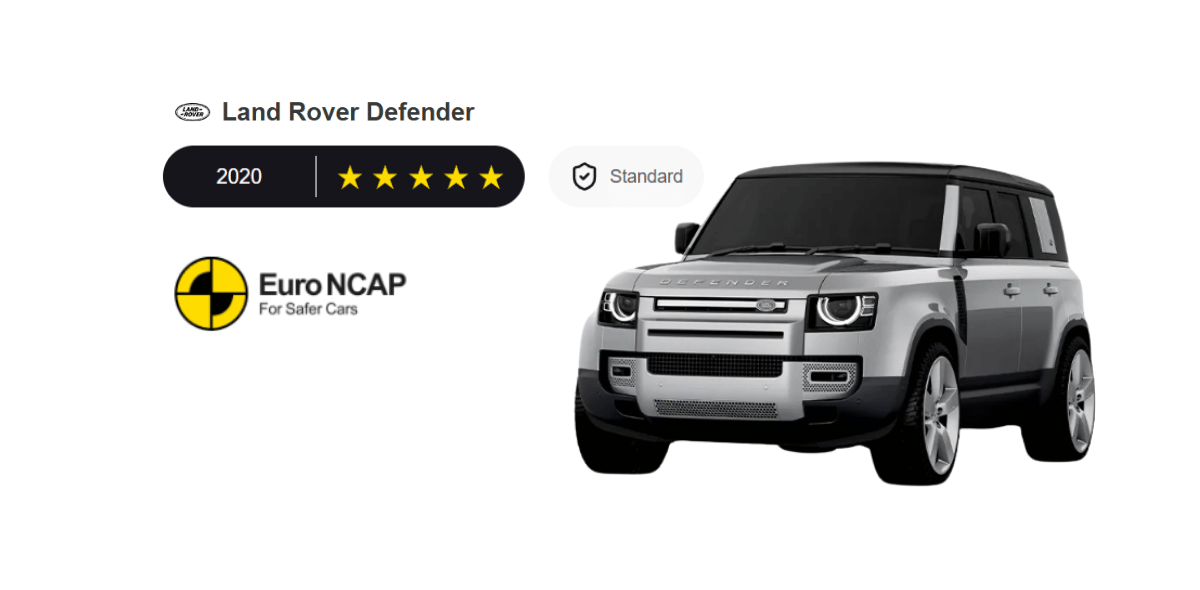
The Land Rover Defender enjoys a 5-star safety rating from EuroNCAP
Over the last 5 years of Euro NCAP ratings, new cars over 2000kg (which includes all large SUVs and pickup trucks) have, on average, received higher scores for Vulnerable Road User safety than less heavy cars. In contrast to this favourable picture, analysis of UK road crash data suggests that cars over 2000kg in weight raise the odds of adult vulnerable road user fatality by 21%, and for children under 10-years-old by 154%, compared to a collision with a lighter car.
We are concerned that the revised Euro NCAP testing regime will further cement this imbalance, with improved active safety trumping declining passive safety, leading to large SUVs achieving high safety ratings that mask their potential to cause harm.
Regulatory gaps
In addition to Euro NCAP misleadingly labelling large, heavy SUVs and pickups as safe, regulatory gaps between the UK and EU leave loopholes for the importation of dangerous vehicles.
Under the Individual Vehicle Approval (IVA) scheme, foreign-made (especially US-made) are able to be imported to the UK sidelining normal regulations for new cars.
In August 2025, a trade framework between the EU and US was agreed watering down EU road safety standards and risking flooding EU roads with large, dangerous US pickups. The EU is currently tightening its IVA regime, leaving the UK at risk of being exposed to mass market imports that do not comply with (higher) European safety standards.
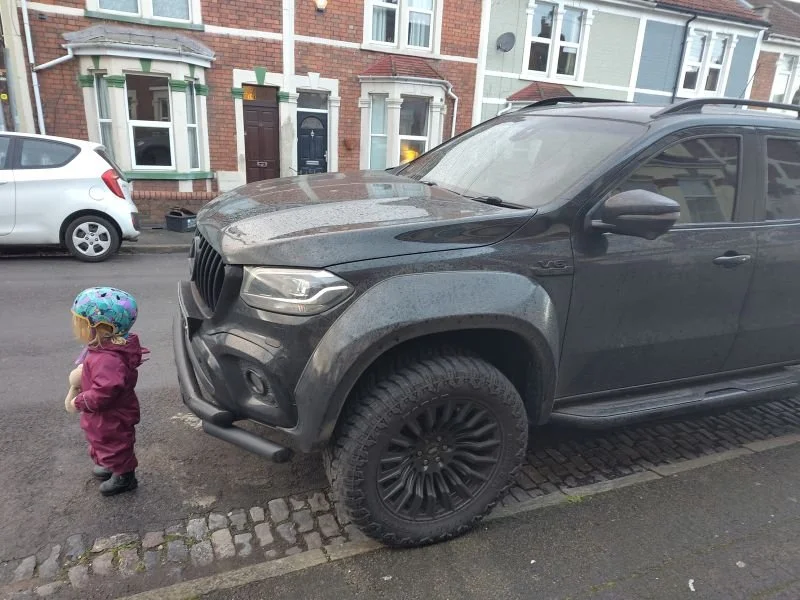
Large, US-style pickups are becoming a more common sight on UK roads. Image credit: Felicia Bjersing.
Perception gaps
A poll of British drivers conducted in April 2026 found that 66% don’t know that SUVs and pickups are more dangerous to other road users, compared to small cars. Even after being shown this information, in the form of tobacco-style warning labels in adverts, over half of respondents still failed to identify that SUVs and pickups are ore dangerous.
More concerning still, being provided with the information about the risk SUVs and pickups pose to other road users, those intending to buy such a car in the future showed almost no reduction in their intention. The implications of this research are that public awareness of the risks of bigger cars is low, and that raising awareness alone is insufficient to change buying habits. Instead, hard policies (like those in the SUV Alliance manifesto) are needed.
What can be done?
Redressing these imbalances calls for a new approach to vehicle safety testing and regulation, one that puts the experience of the most vulnerable road users first.
Different bodies responsible for road safety need to work together: national lawmakers in the UK, international lawmakers in the EU, and safety rating agencies like Euro NCAP.
Our recommendations:
For Euro NCAP (and the UK government to encourage Euro NCAP) to incorporate a “child visibility test” into their testing regime whereby the visibility to the car’s driver (assuming an average height female driver) of a child standing in front of the car’s bonnet is measured and under which cars performing poorly by this metric cannot be awarded top safety ratings;
For the UK government to tighten the Individual Vehicle Approval (IVA) scheme. The EU is currently acting, and after it has tightened its IVA regime, the UK risks being exposed to mass market imports that do not comply with European standards;
For the UK government to ban the sale and use of aggressive features such as ‘bull bars’ fitted to the front of a car;
For a UK-wide public information campaign helping UK motorists understand the risks of large cars and SUVs.
Feature image: composite from Crispin Hughes / Clean Cities / Climate Visuals